Ashkenazi Jews began immigrating to Curaçao from Eastern Europe during the late 1920s. Most came from the former Bessarabia, a border area between Romania and Russia, especially from Novoselitsa and Czernowitz in Bukovina. A few also came from Poland.
From the 1880s onward, many Jews fled Russia, Romania, and other Eastern European countries because of anti-Semitic government policies. Between 1880 and 1923, about four million Eastern European Jews moved westward, primarily to the United States. The Ashkenazi Jews of Curaçao were part of a later wave of this migration. Because the United States had restricted immigration quotas in 1921, 1925, and 1927, Ashkenazi Jews looked to various countries in Latin America.
Very few of the Ashkenazi Jews who ended up in Curaçao had ever heard of the island. Most of them were on their way to other destinations. The ships on which they traveled made Curaçao a port of call mostly to refuel with oil, and they stayed if they learned that the country of their destination was in political turmoil. Moreover, they understood that there was plenty of opportunity in Curaçao.
Some immigrants left after a while, but those who remained sent for relatives. To be a “Landsman” (from the same area) was of great importance. The community members helped newcomers; they were either hired as employees or received credit.
During the first years, the group consisted mainly of young men. There were no potential brides on the island. When one of the men had saved enough money to go back and visit relatives, he would sometimes be given the address of another community member to deliver presents and good wishes to this “Landsman’s” relatives. A few marriages resulted from this. But most of the wives came from Ashkenazi communities in Latin America, such as Argentina, Colombia, and Venezuela.
The Ashkenazi Jews arrived with few economic resources. Some were artisans, but many had background in retailing, and most were used to dealing with different ethnic groups.
At first, they made a living by buying goods from Sephardic wholesalers and peddling them throughout the rural areas of Curaçao. In the early years, they would carry the goods on their backs or pay a local boy to carry part of the load, traveling on foot for days. Later, some transported goods using carts—first without a mule, then with a mule.
They called themselves “knockers” (in Dutch, kloppers) after the Yiddish word for the knock on the door when they tried to sell their wares. Eventually, they stopped peddling altogether, selling first out of small stores on the back streets and then in larger stores on major streets.
With low taxes and little competition, they were able to prosper, even during the economic depression of the 1930s. Although they started with very little, their businesses often became very profitable. They eventually stopped relying on Sephardic wholesalers and began to import goods directly. As sellers and employers, they became increasingly visible to the general Curaçaoan population.
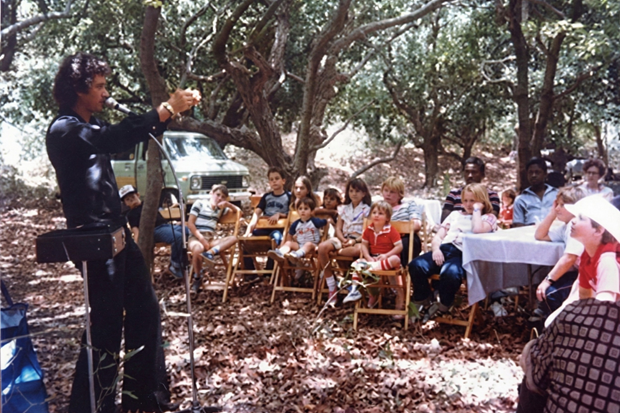
The community maintained a strong Jewish identity. In 1932, they founded a social center (Club Union) and their own sports club. However, a permanent synagogue didn’t come until 1959.
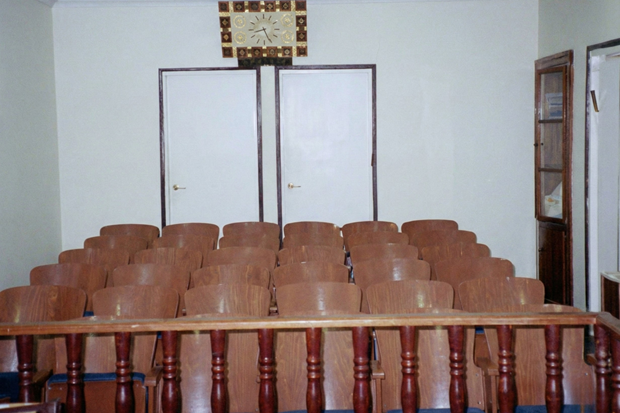
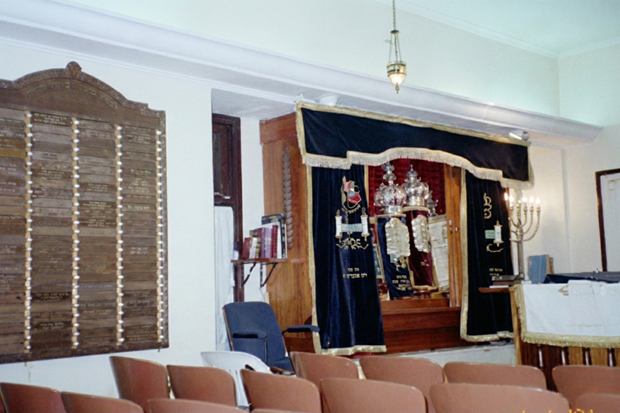
Named Shaarei Tsedek (“Gates of Righteousness”), it was located in a villa at Scharloo (Scharlooweg 39-41), the historic, prestigious neighborhood of the Sephardic Jews. Before this, services were held in rented locations, including the Graham building and spaces on Penstraat and Bargestraat.
Many of the Ashkenazi Jews came from very traditional homes, and from the beginning, the congregation maintained an Orthodox service. A mechitza (separation between men and women) was part of the interior, and Orthodox rabbis were hired to lead the congregation throughout the years.
In the mid-1980s, the congregation sold the synagogue building in Scharloo. The area had begun to deteriorate, and more Ashkenazi Jews were moving east from Punda to the newly built suburban areas.
Following the move, services were held temporarily in a former private home of one of the congregation members located in the residential neighborhood of Mahaai (Lelieweg 1A), close to most members’ homes.
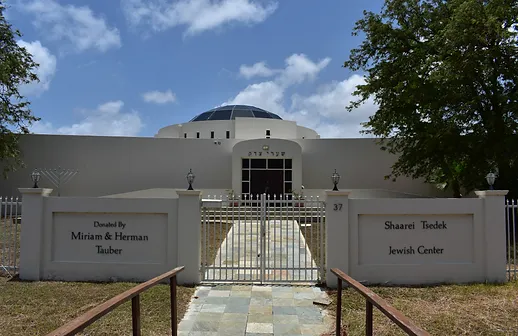
From the beginning, building a new synagogue in Mahaai was on the community’s agenda. The congregation even purchased property for that purpose, but for various reasons, the “temporary” move lasted far longer than planned.
It was not until June 10, 2006, that the long-awaited dream finally came true. This milestone was largely driven by the vision of Rabbi Ariel Yeshurun, who moved to Curaçao with his family in September 2000. He envisioned and enthusiastically inspired the revival of the project, meticulously orchestrating every stage of the process.
Today we proudly present what has been marveled as an architectural masterpiece. One amazing feature is the huge transparent dome which serves as the entire roof of the sanctuary. The magnificence of the striking clear blue sky is simply awe-inspiring.
Many of the Ashkenazic Jews who dreamed of erecting a new shul were no longer alive to witness the initiative bear fruit, yet their immortal contribution was transmitted to us through their pioneering spirit and perseverance. If not for that belief and determination, we would not have had the strength to be so optimistic and willing. If not for their careful and loving conservation of our traditions, Jewish continuity would have been at risk.
The old-timers, those who were always there for the minyan, those who were ever so ready to participate and promote Jewish causes, are the ones who are the true contributors of the new shul and of keeping alive the desire we had for building a beautiful house of worship.
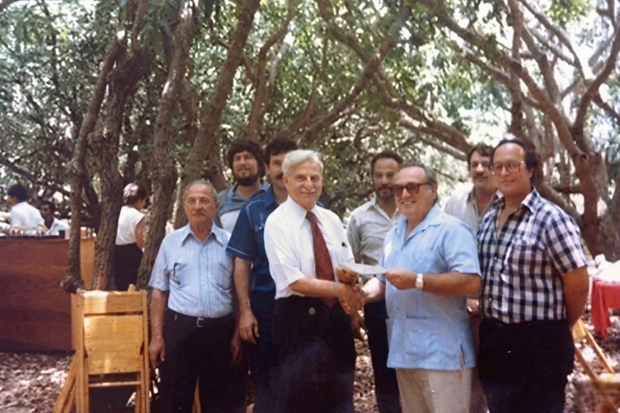
While many participated financially in this project, two families are of noteworthy mention for their outstanding measure of dedication and monetary commitment towards this goal; Herman and Miriam Tauber and Mrs. Janina de Marchena-Katz.
Herman Tauber arrived in Curaçao as a young boy of 13 years. He left Poland alone before the war to join his older brother, Leon, who was already on the island at that time. From very humble beginnings, they painstakingly built a future that later on became a financial empire. Herman met his wife, Miriam, who was a survivor of the war, in New York, and they continued their future in Curaçao, where they had their three children Paulette, Irwin, and Suzy.
The Taubers were known for their philanthropic work in both the United States and in Israel, and they were well received by many dignitaries in the Israeli government. Herman and Miriam’s great benevolence and supreme charitable kindness enabled us to stride forward and further inspired others to contribute. They stand out as the financial cornerstone of the new synagogue, which has been named in their honor “The Herman and Miriam Tauber Jewish Center.”
Mrs. Janina de Marchena-Katz was a very special woman who financially committed herself to the project from the very beginning. A survivor of WWII, she struggled with the challenges of life presented after the war. With practically no family left, she somehow found the inner strength to build a new life for herself in Curaçao. Here she prospered and became a very capable businesswoman. Until her passing, she remained a source of inspiration and generosity in the community.
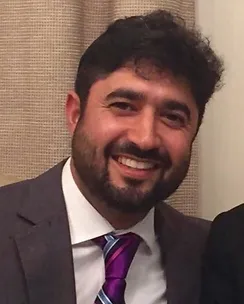
Rabbi Ariel Yeshurun was recruited from Israel at the age of 24 and arrived in Curaçao with his wife and one child in September 2000.
Rabbi Yeshurun is a graduate of the prestigious Chevron Yeshiva Rabbinical College in Givat Mordechai, Jerusalem, and the Beit Amiel Institute for training rabbis for leadership in the Diaspora. He received his ordination in Jerusalem and holds a Rabbinical Advocate degree from the Israeli Ministry of Justice specializing in marital law.
Rabbi Yeshurun served in the capacity of rabbi for the longest tenure since the establishment of the synagogue in the 1950s and has been a source of great inspiration to youth and adults alike.
His greatest achievement by far is the building of the new synagogue, which had been an aspiration of the community for many decades, towards which he relentlessly worked and single-handedly raised the funds.
Rabbi Yeshurun was also an active member of the local Rotary club, where he was able to reach out, through diverse charitable and humanitarian initiatives, to the general population of Curaçao.
The rabbi has also been heavily involved with raising money towards noble causes in Israel. During the Second Lebanon War, the rabbi launched a very successful campaign for obtaining emergency medical equipment for Rambam Hospital in Haifa as well as for purchasing a bulletproof bus to help transport children safely to school.
As of September 2011, Rabbi Yeshurun took up the position of Rabbi of the Skylake Synagogue in North Miami Beach.
References: NWIG, New West Indian Guide/Nieuwe West-Indische Gids
Benjamin, Alan F., 2002. Jews of the Dutch Caribbean Exploring ethnic identity on Curacao
Emmanuel, Issac, 1957. Precious Stones of the Jews of Curacao
Emmanuel, Isaac & Suzanne, A. Emmanuel, 1970. History of the Jews of the Netherlands Antilles